
Got a mortgage rate you like and card balances you don't?
A HELOC is a separate line of credit that sits behind your first mortgage. So using some of your home equity to pay off higher-interest debt doesn't have to mean refinancing the loan you worked hard to get. I'll walk you through what repayment could look like later, before you open anything.
A HELOC is secured by your home. If you don't repay as agreed, you could lose your home. Rates are typically variable, and not all applicants will qualify.

Like your current mortgage rate? Keep it.
A cash-out refinance replaces your whole first mortgage, which can mean giving up the rate you have. A HELOC is a separate line that sits behind it, so your first mortgage, rate and payment can stay as they are. I'll lay both side by side so you can see the difference.
See how a HELOC compares to a cash-out refinancePaying off high-interest debt with a HELOC. The honest version.
Credit cards and other high-interest balances are one of the most common reasons people look at a HELOC. Rolling them into one line that may cost you less over time can make real sense, but it deserves a close look first.

What it may do
Combines several high-interest balances into one line. Depending on the rate, fees and repayment timeline, the total cost may come out lower. It also may not, which is why I compare it before you decide.
What to weigh
That debt is now secured by your home. If you don't repay as agreed, you could lose it. A lower monthly payment can also mean a longer timeline and a higher total cost. And once the cards are paid off, the balances can creep back up.
What I'll do
I'll add up what you owe and what it costs you today. Then I'll compare a HELOC, a cash-out refinance and a personal loan side by side, and show you the payment in the repayment period too, not only the first one. If it doesn't improve your overall picture, I'll tell you.
See your debt in one clear picture.
A few cards and a few balances can add up to a bigger monthly cost than you might think. Add your balances to see what your debt may be costing you, then explore what one home equity payment could look like.
Other common reasons people use a HELOC

One big expense.
Tuition, a medical bill or a family need. Paying the bill is the easy part, so plan how you'll repay it over the years that follow.

Money ready if you need it.
A backstop for a surprise repair or a change in income. Some lines charge fees even if you never use them.

A home project.
Draw as each contractor bill comes in. Settle on a budget before you pick finishes, since projects tend to grow. Ask me about renovation-focused programs for larger remodels.
A HELOC has two phases. Plan for both.
It's easy to focus on the first phase. The second one is where people get surprised.
The draw period
You get approved for a credit line backed by your home equity. You borrow from it when you need to, pay it down, and may be able to borrow again. You generally pay interest on what you've drawn.
The part that feels easy. Payments can be lower here, and that's exactly why it's easy to stop thinking past it.
The repayment period
The line closes to new draws and you start paying back principal on the balance that's left. Your payment can go up, sometimes a lot, even if the rate doesn't change.
The part to plan for now. I'll show you what this payment could look like before you open the line.
If you're paying off cards, this phase matters most. The balance moves to a line you'll be repaying for years.
You're borrowing against your house.
If that sentence makes you a little uneasy, good. It should get a real conversation. Here's what changes when you open a HELOC.
Your home is the collateral.
If you can't repay, your home is at risk. That's the trade for a rate that may be lower than unsecured credit.
The rate is usually variable.
It can move with the market, and your payment moves with it. I run a few rate scenarios, not just the best one.
The payment changes later.
When the draw period ends, principal kicks in. Today's payment isn't the whole story, so I don't sell it like it is.
Two kinds of HELOC for paying off debt. One fits you better.
I'm a broker, not a bank, so I'm not stuck selling one product. I compare HELOC programs across my 40+ lending partners to find the one that fits you, and I'll walk you through the pros and cons of each.
Traditional HELOC
The classic version. Open the line, draw what you need, pay it down, and borrow again during the draw period. You generally pay interest on what you've used, and your first mortgage can stay in place.
Where it hurts: The rate is usually variable, and the payment climbs when repayment starts. Room you don't use can feel like a safety net, and it can make it easier to run balances back up.
5-Day HELOC
Set up online, often without an in-person appraisal, with funding in as few as five days for files that qualify. Some versions offer fixed-rate options, which can take some of the rate guesswork out.
Where it hurts: You take the full amount at closing and pay interest on all of it from day one, and an origination fee may come out of your proceeds. Size it to the number you actually need.
Funding timelines depend on the property, your documentation and underwriting, and aren't guaranteed. Program availability and terms vary by lender and are subject to change.
Remodeling instead? A renovation-focused HELOC may fit a larger project. Ask me about it.
Not sure which one fits? Tell me what you owe and I'll lay them side by side.
Book a 15 minute callBorrow what you need, not what you qualify for.
Your approval amount is a ceiling, not a recommendation. A bigger line doesn't mean you need to use it, and it can make it easier to borrow more than the job calls for. If you can answer these five out loud, you're making a decision. If you can't yet, that's what the first call is for.
What am I borrowing for?
Finish the sentence: "I'd use a HELOC to ___."How much do I actually need?
If it's debt, add up the balances you'd pay off. That's usually your number.What will it really cost?
Rate, margin, fees, and how you'd actually use the line. Not just the headline number.What if the rate goes up?
Would your budget still work if the payment rose? Find out now.How will I pay it back?
Name where repayment comes from: your budget, a bonus, savings. And how you'll keep the old balances from coming back.
How a HELOC compares to the other ways to tap your equity
Here's where a HELOC fits next to the other ways to use your equity. The right choice depends on the job, your current mortgage, and how sure you are about the number. I'll lay out all four for your situation.
The table compares four options on how you get the money, what happens to your first mortgage, how the rate behaves, whether your home secures the debt, when each one may fit, and where each one can hurt.
| HELOC | Home equity loan | Cash-out refinance | Personal loan or card | |
|---|---|---|---|---|
| How you get the money | Draw as needed, pay down, draw again | One lump sum | One lump sum at closing | Lump sum (loan) or revolving (card) |
| Your first mortgage | Stays in place | Stays in place | Replaced with a new loan | Untouched |
| Rate behavior | Usually variable | Usually fixed | Fixed or adjustable | Often higher, cards usually variable |
| Secured by your home | Yes | Yes | Yes | Generally no |
| Tends to fit when | Costs come in stages, you want a backstop, or you want to pay off balances and keep your first mortgage | You know the exact number and want a set payment | Your current rate is higher than today's options | The amount is small and you'd rather not involve the house |
| Where it hurts | Payment can rise with rates and at repayment | Interest on the full amount from day one | Can mean giving up a first-mortgage rate you like | Higher cost on larger balances |
Terms vary by lender and your situation. Not every option is available to every client.
Know what you're committing to before you commit.
Download the guide and learn how HELOCs work, what to compare, and what to ask before you decide. No pressure to open anything.
HELOCs made simple
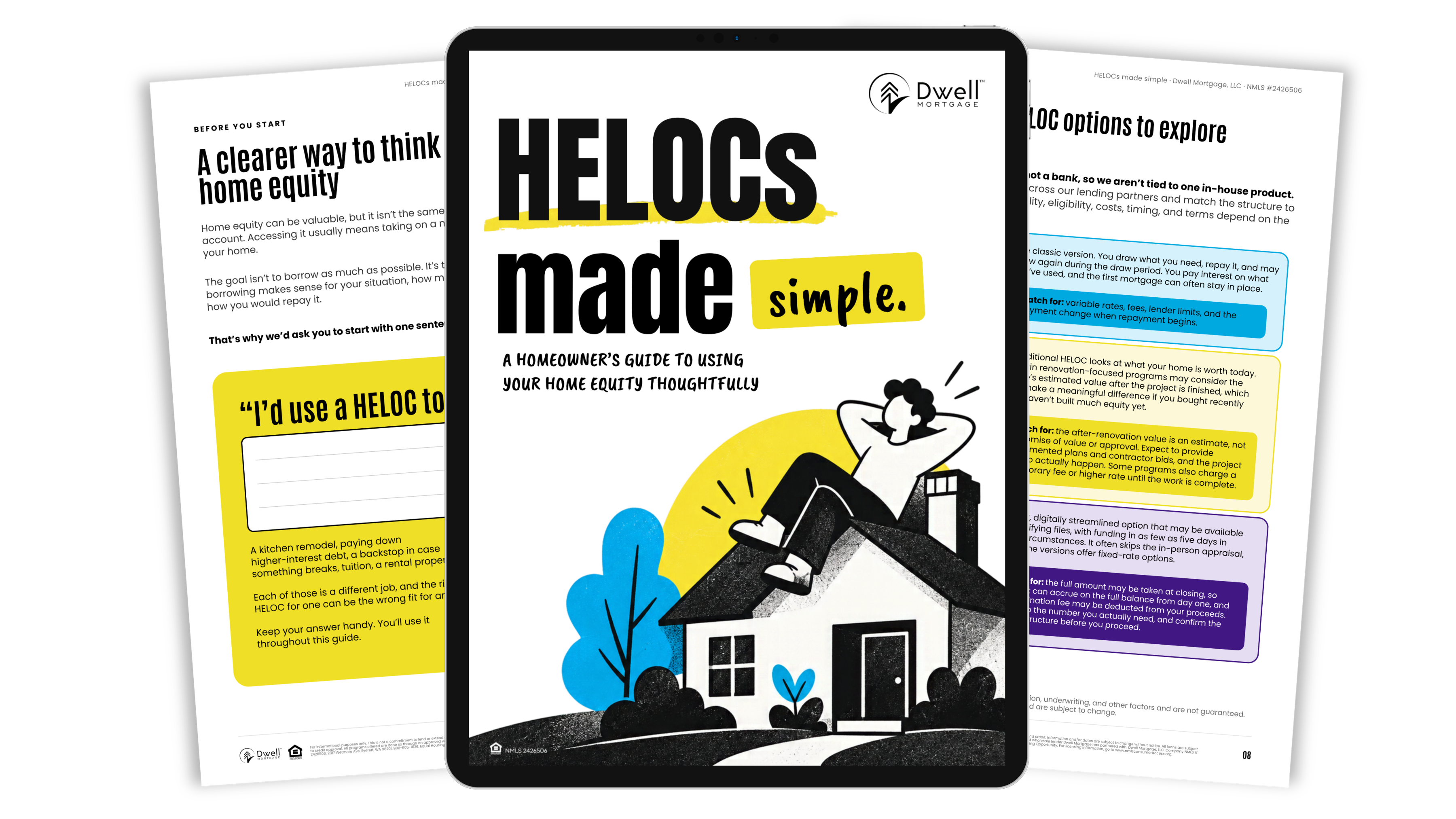
A homeowner's guide to using your home equity thoughtfully. What a HELOC is, what to compare, what to watch out for, and how to decide if one fits your plans.
- How a HELOC works, without the mortgage jargon
- Three kinds of HELOC and the job each one fits
- How a HELOC compares to a cash-out refinance and a personal loan
- The costs, risks and questions to ask before you decide
- A planning worksheet to map how much you need and how you'd repay it
Where should I send it?
The guide lands in your inbox right away, and you can reach out with questions anytime.
Downloading the guide doesn't touch your credit, and there's no obligation.
The HELOC questions people ask me. Straight answers.
Can I use a HELOC to pay off credit cards?
Yes, many people do. A HELOC may reduce what your balances cost you in some situations, but it turns unsecured debt into debt secured by your home. I compare total interest, fees and the repayment timeline, not only the monthly payment, and I'll tell you if it doesn't improve your overall picture.
Do I have to refinance my current mortgage?
No. A HELOC is a separate line that sits behind your first mortgage. If you like the rate and terms you have, they can stay as they are.
What happens when the draw period ends?
You can't draw new money, and you start repaying principal on the remaining balance. That usually means a higher payment. I map that payment out with you before you open the line, so it's part of the decision instead of a surprise.
What if rates go up?
Most HELOCs carry a variable rate, so your payment can rise. I run a few scenarios at different balances and rates so you can see whether your budget still works if things move against you.
Will a HELOC affect my credit?
Applying usually involves a credit check, and a new account and balance will appear on your credit report. I'll explain what to expect before anything is pulled.
How much can I borrow?
It depends on your home's value, what you owe, your credit and income, and the lender, and not all applicants qualify. I'd flip the question: how much would actually be useful to you? I'll help you size the line to the job.
Isn't a HELOC basically a credit card?
They both revolve, but that's where it ends. A HELOC is secured by your home, it has a draw period and a repayment period, and missing payments puts the house at risk. It deserves more thought than a card.
Are there fees?
Sometimes. Depending on the lender, there can be appraisal costs, annual fees or minimum draw requirements. I lay out the whole cost based on how you'd actually use the line, so you're not paying for convenience you don't need.
Why go through a broker for a HELOC?
HELOC terms vary a lot from lender to lender. Dwell is an independent broker, not a bank, so I can compare options across 40+ lending partners and look at your whole picture, first mortgage included.
You have an asset. Let's see if this is the right tool.
If a HELOC fits, I'll help you size it right. If it doesn't, I'll tell you that too and point you toward what does.